Most distributed storage architectures lock their replication topology into their core design: Ceph peers a primary OSD with replicas, Cassandra has clients fan out to coordinators, and HDFS pipelines a daisy-chain of DataNodes. Each topology optimizes for one constraint at the expense of the others — low latency, low network egress, or even bandwidth distribution.
momo was designed around an alternative premise: why hardcode a single replication topology when network conditions, hardware heterogeneity, and client types shift over time? The Polymorphic Engine lets a running momo cluster change its active replication strategy without restarting daemons or dropping in-flight connections.
Here, replication simply means keeping multiple copies of each object across different machines, and replication factor (written R below) is how many copies we keep. The interesting question is the shape of the write path that creates those copies.
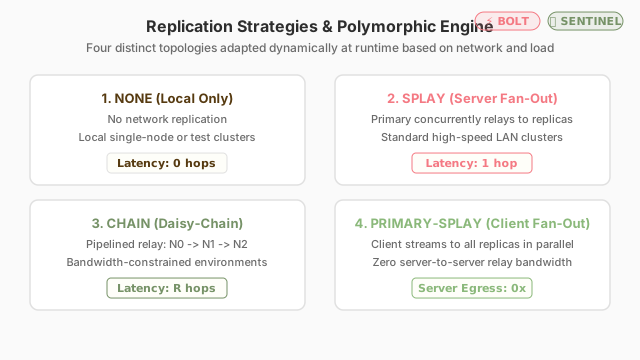
1. The Core Topologies: Splay vs. Chain
momo formalizes four replication modes:
| |
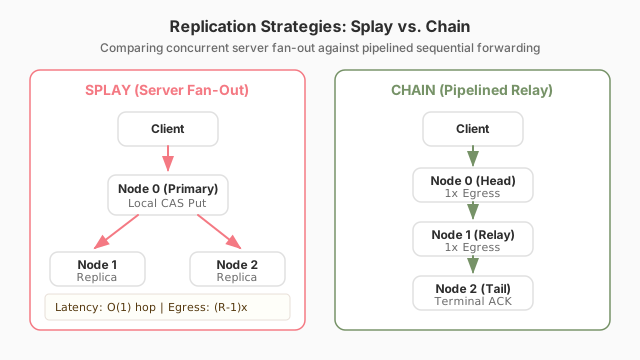
Splay Replication (Mode 1)
The client sends one stream to the primary node, call it the first node. That node writes the payload to its local blob store while simultaneously fanning out concurrent streams to the secondary replicas. The shape is a fan or “splay”: one inbound stream becomes several outbound streams.
- Latency: one network hop — the fastest write latency.
- Cost: the primary node carries
(R - 1) × payloadof network egress bandwidth, creating a bottleneck on the primary’s network card.
Chain Replication (Mode 2)
The client streams to the first node, which streams directly to the second, which streams to the third. Each node forwards to exactly one successor.
- Latency: R sequential hops — higher write-completion latency, because the write is not durable until it reaches the tail.
- Cost: every node spends exactly one unit of ingress and one unit of egress bandwidth. No single node’s egress saturates, which makes chain the right choice for large sequential transfers across bandwidth-constrained links.
2. Primary-Splay: Client-Side Fan-Out
In Primary-Splay (Mode 3), the momo client computes the replica set locally (via CRUSH-lite, 005) and connects directly to all R nodes in parallel.
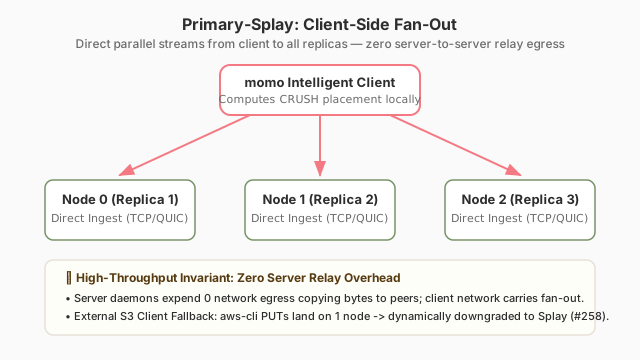
- Zero server relay bandwidth. Daemons spend no egress copying bytes to peers; the client’s network carries the fan-out.
- Dynamic downgrade invariant. When a non-momo client (say
aws-cliorcurl) connects, it sends only a single stream. The receiving server detects that the peer is external and automatically steps down from Primary-Splay to Splay, so the write still gets replicated instead of silently landing as one copy.
3. The Polymorphic Controller
Replication modes are not static configuration flags; they are dynamic cluster states. One node — node 0 — is the single authoritative controller. It is the only node allowed to decide and broadcast a topology change, which prevents two nodes from racing to reconfigure the cluster.
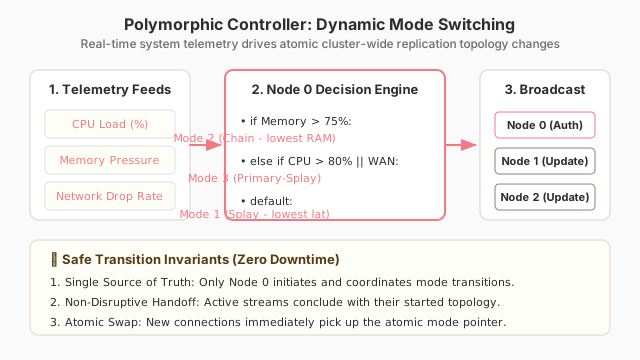
| |
When a node receives a mode change, it updates an atomic integer holding the current mode. Ongoing in-flight streams keep using the mode they started with and run to completion; newly accepted connections immediately adopt the new topology. The result is a topology shift with zero downtime and no dropped transfers.
4. Tradeoff Analysis
| Mode | Write Latency | Primary Node Egress | Inter-Node Traffic | Client Requirements |
|---|---|---|---|---|
None (0) | Lowest (no hops) | Zero | Zero | Works with any client |
Splay (1) | Low (one hop) | High ((R-1) × payload) | High | Works with any client |
Chain (2) | High (R hops) | Low (1 × payload) | Distributed evenly | Works with any client |
Primary-Splay (3) | Low (one hop) | Zero | Zero | Requires momo-aware client |
The trade-off is genuine: Primary-Splay is the cheapest and fastest, but it requires clients that speak momo’s protocol. Splay is universal but makes the primary’s NIC the bottleneck. Chain is the most bandwidth-fair but the slowest to acknowledge. The Polymorphic Engine exists so the cluster does not have to pick one forever.
5. Engineering Standards (⚡ Bolt & 🛡 Sentinel)
In accordance with docs/CORE/STANDARDS.md:
- ⚡ Bolt: strategy selection is a lightweight control-plane decision. The data plane uses pooled stack buffers and bounded semaphores so replication forwarding adds no heap allocations.
- 🛡 Sentinel: in-flight streams are never forcibly interrupted during a topology shift, and single-source authority on node 0 prevents split-brain mode oscillations.
References / Dig deeper
- Replication design doc: docs/REFERENCE/REPLICATION_STRATEGIES.md.
- Spec:
openspec/changes/add-replication-durability-floor. - Sibling posts: 001: Origin and Genesis, 003: TCP → QUIC Transport, 021: R3 Write Durability and Quorum.
- CRUSH-lite placement: 005.