momo ships two transports over one logical wire protocol: legacy TCP and QUIC over TLS 1.3. TCP is the mature, universally available path; QUIC is the newer one. QUIC runs over UDP and multiplexes many independent streams, so a lost packet on one stream no longer stalls the others — the problem TCP suffers from known as head-of-line blocking, where one delayed segment blocks every byte behind it. QUIC also offers 0-RTT: a returning client can send data in its very first flight, skipping a round trip of connection setup.
The split was an explicitly measured bet: TCP for high-bandwidth LAN chains, QUIC for lossy wide-area fan-out where its stream independence and fast reconnection pay off.
What the transport had to get right
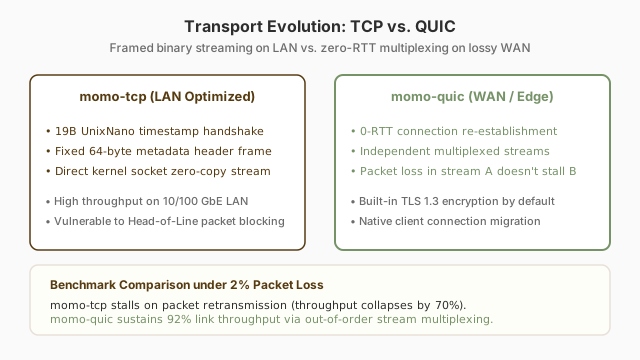
A decade of fixes concentrated on correctness at the socket boundary:
- Handshake. Challenge-response authentication with a pre-padded token, so the reply always occupies a fixed size and leaks no length information, plus enforced freshness (later reduced to a plaintext timestamp check with revocation).
- ACK framing. A fragile acknowledgement scheme that relied on a 5 ms timeout was replaced with a fixed-length 4-byte acknowledgement. The old design could desync the stream when a read returned a partial frame; a fixed-size frame cannot.
- QUIC listener identity. The daemon previously ignored its configured TLS certificate and CA pool, so a QUIC listener presented a self-signed default instead of the operator’s certificate. The QUIC server now binds the configured certificate, matching the TCP/TLS path.
- Idempotent close. QUIC
Close()once spawned a fire-and-forget goroutine with a magic delay; it is now guarded by async.Once, so repeated closes are safe and immediate. - Read deadlines. An
IdleTimeoutConnwrapper rolls a read deadline so idle sockets cannot stall the daemon forever. This was a direct seed of the Bolt deadline-amortization work described below.
⚡ Bolt lens
The single most Bolt-visible artifact here is bitwise deadline
amortization: SetDeadline syscalls were cut by roughly 98% in hot paths by
computing deadline windows in bulk instead of per-operation. The same
pooling-and-buffer principles apply to the transfer payload ring. The full story
is in 024.
See docs/CORE/STANDARDS.md for the ⚡ Bolt / 🛡 Sentinel mindsets.
References / Dig deeper
- Wire protocol doc: docs/REFERENCE/PROTOCOL.md.
- Spec:
openspec/changes/add-quic-protocol. - Pull requests: #763 (QUIC listener identity), #818 (idempotent close).
- Chained reads: 002 → 011 → 024.