The strongest security guarantee a cloud storage system can offer is simple: even if an attacker gains full root access to the storage nodes, the physical disks, and the metadata databases, they cannot read a single byte of customer data.
For a long time we did not have that guarantee. Encryption-at-rest protected the disks, but the servers still held the keys, so a rogue operator or a compromised daemon could read anything. We wanted a design where the server is structurally incapable of reading the data it stores — not merely trusted not to. That is end-to-end encryption (E2EE): the data is encrypted on the client and stays ciphertext everywhere else. momo implements it as client-held envelope encryption, across both its S3 gateway and its native binary transport.
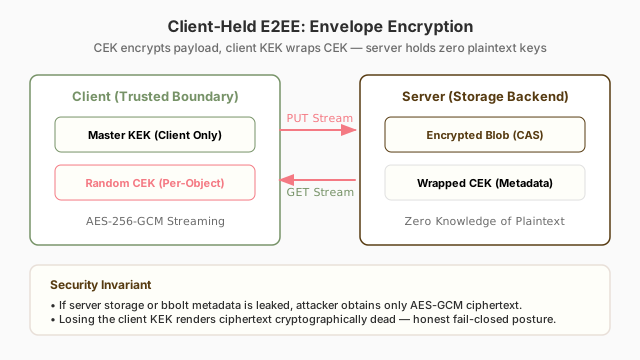
1. The Key Hierarchy: KEK, CEK, and Envelopes
The obvious first idea is to encrypt every file directly with one long-lived key. We rejected it for two concrete reasons:
- Key wear-out. AES-GCM requires that the same key never be reused with the same nonce. A single key encrypting terabytes of data will eventually repeat a nonce, and a nonce repeat is catastrophic — it can leak the XOR of two plaintexts. One key cannot safely cover an unbounded amount of data.
- Rotation nightmares. If that one key is ever compromised, re-securing petabytes means reading, decrypting, and rewriting every physical block on disk. A rotation that should be a metadata operation becomes a full data migration.
Envelope encryption solves both by splitting one key into two. The data itself is encrypted with a short-lived key, and that short-lived key is encrypted with the long-lived key. The long-lived key never touches the data directly, so it can be rotated cheaply.
The three pieces:
- Content Encryption Key (CEK) — also called a data key. A fresh, high-entropy 256-bit AES key generated randomly in client RAM, used for exactly one object.
- Key Encryption Key (KEK) — the client’s long-lived master key. The KEK never leaves the client device. It is never transmitted across the network and never stored in server configuration.
- Wrapped CEK — the client encrypts the 32-byte CEK under its KEK
(
AES-256-GCM.Seal(KEK, CEK)). The resulting small encrypted blob, the “envelope”, travels alongside the ciphertext.
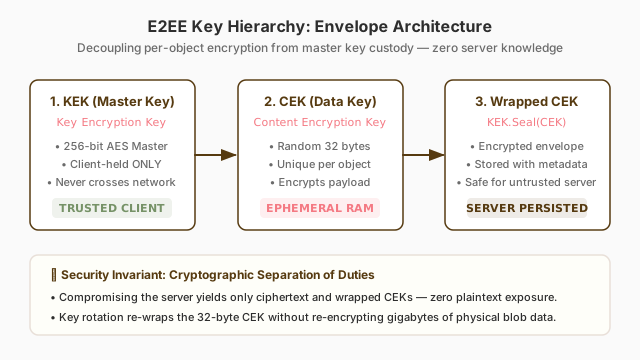
Because the KEK only ever wraps a 32-byte key, rotating it means re-wrapping one small envelope per object — constant work per object, regardless of how large the object is. That is the whole point of the split.
2. The Ingest (PUT) Pipeline
During an upload, encryption happens entirely before any byte crosses the network boundary. The client generates the CEK, wraps it, and streams the payload through an encrypting reader:
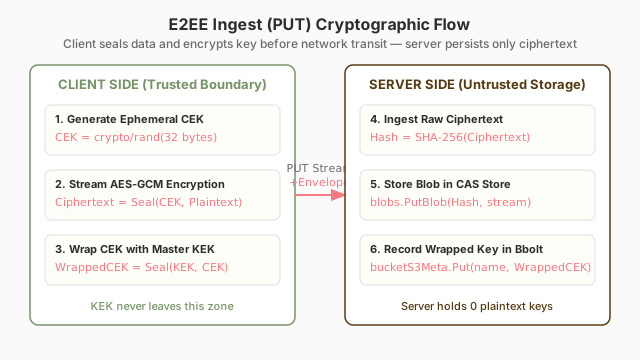
The encryption helper in the crypto core looks like this:
| |
The server receives only the raw AES-GCM ciphertext stream and the JSON envelope. It indexes the envelope in its metadata store and writes the ciphertext directly into the content-addressed blob store. At no point does a plaintext byte or the KEK reach the server.
3. The Retrieval (GET) Pipeline
When downloading, the process is inverted. The server can only ever hand back ciphertext; the client does all the decryption:
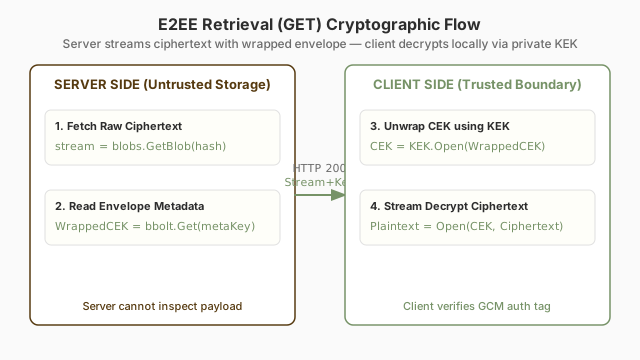
- The server streams the raw ciphertext blob from disk and includes the
WrappedCEKenvelope in the response headers. - The client receives the envelope, extracts the wrapped key, and unwraps it
locally using its private KEK (
CEK = KEK.Open(WrappedCEK)). - The client streams the ciphertext through an AES-GCM decrypting reader, verifying the authentication tag in real time as bytes arrive.
A tampered or truncated payload fails authentication before the client ever consumes it, so the client never acts on unverified bytes.
4. Trade-off Analysis
Envelope encryption is not free. Here is what it buys and what it costs against the alternative of server-side encryption, where the server holds the keys:
| Metric / Dimension | Server-Side Encryption (SSE-S3) | Client-Held Envelope Encryption (E2EE) |
|---|---|---|
| Server trust assumption | Server holds keys; a rogue admin can read data | Zero trust: server holds only ciphertext |
| CAS deduplication | Preserved (plaintext hashes match) | Neutralized (a random CEK produces unique ciphertext) |
| Key rotation overhead | Requires re-encrypting all stored blobs | Constant time per object: re-wrap only the 32-byte CEK |
| Client CPU overhead | Zero client CPU | Client performs AES-NI encryption/decryption |
| Data loss risk on key loss | Recoverable via server/cloud KMS | Permanent: a lost KEK means the data is irrecoverable |
The deduplication row is the one that hurts most. Because every object gets a fresh random CEK, two identical files encrypt to two different ciphertexts, so the store can no longer collapse them. We treat that as an acceptable price for true zero trust, and we claw some of it back with a separate confidential-deduplication protocol rather than by weakening the encryption.
5. Security Invariants (🛡 Sentinel Mindset)
In accordance with docs/CORE/STANDARDS.md:
- 🛡 Sentinel (truncation defense). Streaming AES-GCM carries an authenticated
integrity footer. If an attacker truncates a file in transit or deletes trailing
disk blocks, the client’s GCM tag verification fails with
syscall.EBADMSG, which prevents partial-read vulnerabilities where a client might act on a silently shortened object. - 🛡 Fail-closed key semantics. If a client attempts to decrypt an object with an invalid KEK, decryption halts immediately. The server never attempts “fallback” plaintexts or heuristic recoveries — a failure to authenticate is always a hard stop, never a guess.
References / Dig deeper
- Encryption implementation:
src/crypto/envelope.go. - Spec:
openspec/changes/add-e2e-encryption. - Pull requests: #779, #781.
- Sibling posts: 006: Pluggable Storage Backends, 014: Confidential Dedup via OPRF, 015: The Sentinel Sweep.