Momo’s cluster has no leader. Nothing decides which machines exist, which are healthy, or where data belongs. Every node runs the same membership logic and converges on the same view of the ring — we call it a masterless ring. That view has to survive nodes joining, dying, and returning, and keeping it correct is the entire job of the gossip layer in this post.
Two ideas do the work. Gossip is a rumor mill: each node periodically swaps small summaries with a random handful of peers, and any fact one node learns spreads through the cluster without a central broadcaster. SWIM (Scalable Weakly-consistent Infection-style Membership) is the failure-detection protocol layered on top: a node pings a peer to check it is alive, and if the ping goes unanswered it asks several other peers to ping on its behalf before declaring the target dead. That indirect step is the trick — one congested link can no longer produce a false death sentence.
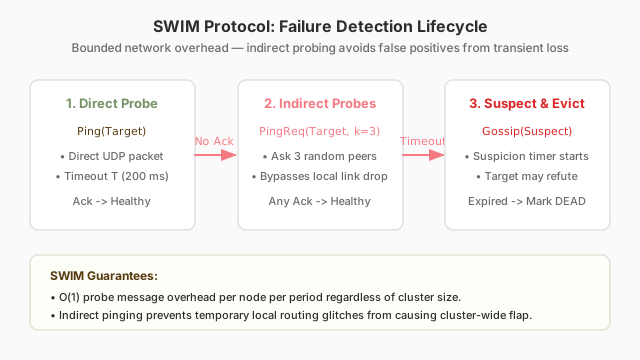
Failure detection, and the bugs that broke it
Nodes exchange heartbeats, pings, and acknowledgements, and mark each other ALIVE or OFFLINE. The design is simple; the interesting part was everything the first implementation got wrong.
- Discovery that never dialed. An early audit caught that the discovery step produced peers nobody actually connected to. Dynamic membership simply did not work: a new node could be “known” and still be unreachable. The fix wired the three steps together — discover, dial, then record the peer in the map.
- Peers stuck dead forever. A peer that had been marked OFFLINE stayed OFFLINE even after it recovered. The fix lets a ping, acknowledgement, or heartbeat revive a peer, so the ring self-heals without a restart.
- Leaks on disconnect. Closed connections and detached peers were never removed from the in-memory peer and connection maps, leaking memory every time a node left. The fix prunes both on disconnect.
Why gossip instead of a coordinator
A coordinator would have to be authoritative, which means a leader election, a single point of failure, and a node whose view of “the config” everyone else trusts. Momo avoids that: every node computes data placement itself from the same deterministic placement function plus the current membership list. The only thing that has to converge is membership, and gossip is how it converges. Higher-level operations — listing metadata, acquiring leases — ride on top of that converged view rather than on a central server.
Keeping it cheap
Membership runs on every node forever, so it is held to a tight allocation budget. The ping counter became a 64-bit atomic, avoiding a 32-bit wraparound; the hostname is cached once at startup instead of recomputed for every metrics scrape; and the random peer selection is seeded from a secure source so the shuffle is unbiased. Later, gossip fanout itself became adaptive to cluster size, covered in 018, so a hundred-node ring does not flood a three-node lab cluster with traffic.
References / Dig deeper
- Cluster design doc: docs/REFERENCE/P2P.md.
- Spec:
openspec/changes/add-p2p-transport. - Membership fixes: PR #808, PR #809; discovery audit issue #598.
- Sibling posts: 017: Scatter-Gather and Lease Consensus, 018: Adaptive Scaling.