Two earlier milestones answered “what happens when data dies” — where copies live, and how we recover a corrupted one. But they left the most uncomfortable question untouched: when we tell a client a write succeeded, what exactly have we promised?
For a long time the honest answer was “not much.” We returned success as soon as the bytes were handed to the operating system. If the machine lost power a millisecond later, those bytes might still be sitting in volatile page cache and simply vanish. The client believed its data was safe. It was not.
The Real Problem
A write acknowledgement is a promise about the future: this data will survive. If we acknowledge before the data has actually reached durable storage, every restart window becomes a silent data-loss window. “ACK then restart = lost object” is exactly the kind of guarantee failure that erodes trust — not loud, not crashy, just quietly missing data.
Two notions of “written” were being conflated:
- the bytes are in memory somewhere in the pipeline, and
- the bytes are safely on disk on enough machines to survive a failure.
R3 makes the acknowledgement mean the second one.
Why the Obvious Solutions Failed
“Acknowledge immediately, persist in the background.” Fast, and wrong for durability. It trades a latency win for invisible data loss on crash.
“Always fsync on every write.” Correct, and painfully slow. Forcing a disk flush on every small write serializes throughput and turns a fast engine into a sluggish one.
“Acknowledge after one node writes.” This ignores the whole point of replication: if that one node dies, the “successful” write is gone. Success has to reflect what survived, not what one machine happened to accept.
The Solution: Define Success Explicitly
R3 ships a durability barrier with three movable parts, so operators can pick the trade-off deliberately instead of inheriting whatever the implementation happened to do.
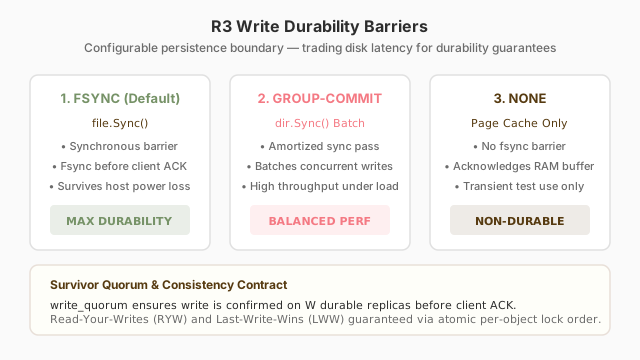
- fsync-before-ack. A write is acknowledged only after the blob has durably
hit disk — not just page cache — on the surviving replicas.
fsyncis the system call that forces the operating system to flush buffered writes all the way to physical media; before it returns, the data is genuinely persistent. This is the change that kills the “ACK then restart = lost object” window. - Group commit and a
nonemode. A configurable barrier with three settings:fsync(flush every write, strictest),group-commit(batch several writes into one flush, trading a little latency for a lot of throughput), andnone(no flush, fastest, least durable). Operators choose their strictness explicitly rather than discovering it by accident. - Survivor quorum. Success requires the required number of surviving replicas to confirm the flush. A quorum is simply a threshold of confirmations — you only report success when enough independent copies have agreed the data is safe, following the same lease and quorum logic we use elsewhere for consistency.
- Read-your-writes. After an acknowledged write, a subsequent read of that object returns the acknowledged data — never an older version. This closes the confusing gap where a client writes something, reads it back, and finds stale bytes.
Group commit, plainly
The interesting design choice is group commit. Instead of one flush per write, we let a small batch of writes accumulate and share a single flush. Ten writes that would have caused ten disk round trips now cause one. The writers all wait for the same flush and are acknowledged together. Latency per write rises slightly; throughput rises sharply. For workloads with many small writes, that is a good trade — and crucially, it is an explicit one.
The Durability Floor in Practice
The durability work also closed a set of silent correctness gaps around replication forwarding. A later audit-era batch bounded the whole layer:
- no silent acknowledgement when forwarding to a replica failed;
- no blocking on a semaphore without a context deadline (so a stuck replica could not hang a writer forever); and
- correct behavior when a delete was only partially propagated.
Each of these was the same class of bug: the system reporting success for work it had not actually completed. R3’s principle — ack only what survived — is what let us find and fix them.
The Sentinel Lens
fsync-before-ack is the Sentinel reading of the word “success”: a client must never observe a lie about durability. The three R-milestones fit together:
- R1 — where replicas live.
- R2 — what survives corruption.
- R3 (this) — what “written” actually means.
Together they discharge the P0 durability and consistency mandate.
What Could Go Wrong
nonemode is genuinely unsafe. It exists so the trade-off is explicit, not so it is free. A crash can silently lose acknowledged writes.- A quorum that cannot be reached. If too few survivors are healthy, the write fails rather than lying. That is correct, but it means availability depends on having enough replicas in distinct failure domains.
- Group commit under light load. With only one write in flight there is nothing to batch, so latency looks like plain fsync. The win only appears under concurrency.
When NOT to Use This
- Scratch or regenerable data. If losing a write after a crash is genuinely
acceptable,
nonemode is a legitimate choice — just make it a conscious one. - When the bottleneck is the network, not the disk. fsync-before-ack adds latency; if disks are not the durability risk you care about, measure before paying for strictness.
- As a substitute for replication. The barrier tells you what survived. It does not create copies — R1 and R2 do that.
References / Dig deeper
- Failure-domain placement: 019.
- Degraded read and self-heal: 020.
- Scatter-gather lease quorum: 017.
- Replication strategies: 002.
- Production readiness roadmap: 028.
- Specs:
openspec/changes/r3-durability-consistency,openspec/changes/add-replication-durability-floor; PR #954; tracking issue #928. - Audit-era durability batch: 015.