For three releases momo was an object store: you wrote bytes under a key and read them back by that key. Then we asked a question that turned out to be the biggest architecture bet yet — can it also behave like a filesystem? Not a filesystem bolted on top, with its own separate storage and its own separate consistency rules, but a filesystem whose substrate is the object store we already had. R4 is the answer: a POSIX core, tracked by the R4 issue and shipped in the R4 pull request.
The Real Problem
An object store and a filesystem disagree about what an object is. A filesystem organizes bytes into a tree of named files and directories with metadata — permissions, ownership, timestamps — and expects operations like rename to be atomic. An object store knows only immutable blobs addressed by a key. If we tried to run both by keeping two separate stores, we’d immediately own two sources of truth: a file written one way would have to be copied into the other, and the copies would eventually disagree.
So the real requirement was harsher than “add a filesystem.” It was: one store, visible through two interfaces. An object written through the native API must appear in the filesystem tree, and a file written through the mount must be a real object — with no syncing, no second database, and no window where the two views disagree.
We had one asset that made this plausible. The object store is content-addressed (see the CAS post): every blob is named by the SHA-256 hash of its own bytes, so identical content collides on purpose and deduplicates for free. If the filesystem layer could be built entirely out of content-addressed objects, consistency would not be a synchronization problem at all — both interfaces would simply be reading and writing the same named bytes.
Why the Obvious Solutions Failed
A separate metadata database for the tree. The conventional filesystem design keeps an inode table and a directory index in their own database. We rejected it because it recreates exactly the two-sources-of-truth problem we were trying to avoid: the tree and the object store could drift, and reconciling them would be someone’s full-time job.
Reusing the existing key/value namespace as the tree. We could have mapped
/a/b.txt onto a single object key a/b.txt. That gives you a flat map, not a
filesystem: there is no directory object to readdir, no place to store POSIX
metadata per entry, and rename becomes a multi-key rewrite that cannot be atomic.
Treating directories as empty marker objects. A zero-byte “directory” object
has nowhere to record its children, so listing a directory means scanning every
key for a prefix — correct but O(n) per readdir, and it still cannot express
hardlinks, where two names must point at one underlying file.
Each of these solved the visible problem (expose files) while quietly deferring the hard part (one consistent substrate). We wanted the opposite trade.
The Solution: The Tree Is Made of Objects
The R4 core reuses the content-addressed store as the byte layer and invents a metadata layer on top of it. The whole design rests on one mapping:
- Directories are content-addressed manifests. A directory is itself a stored object whose contents are a list of entries — each entry pairs a name with the address of a child (its manifest or blob) and carries POSIX metadata such as mode, owner, and group. Because a manifest is an object, it is immutable and versioned by its content hash: changing a directory means producing a new manifest, and the old one remains addressable.
- Files are the existing blobs themselves. File content is hash-addressed exactly like any other object, so deduplication applies to file data with no extra machinery.
- Inode metadata rides alongside each manifest or blob. POSIX attributes are not a separate table; they travel with the object that represents the entry.
The payoff is the property we were after. A directory listing such as
mkdir x followed by writing a file inside it is, underneath, one manifest object
and one blob object: a single store that is simultaneously an S3-style key space
and a POSIX tree. Consistency across the two interfaces falls out for free,
because there is only ever one manifest to read.
| |
What Came With It
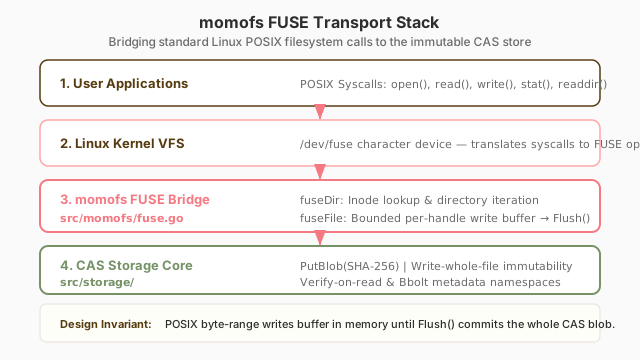
The core implements the operations a filesystem must answer — lookup,
getattr, setattr, readdir, open, create, read, and write — against
the content-addressed layer rather than a local inode table.
The subtler work was atomic rename and hardlinks. A rename must be atomic from a reader’s perspective: either the old name or the new name, never a half-moved entry. Because a directory is a manifest and manifests are immutable, a rename rewrites one manifest and swaps it in a single step — a reader sees the old manifest or the new one, never both. Hardlinks are the reverse pressure: two names point at one content, so the filesystem has to keep a reference count telling the garbage collector how many live names still need the bytes. We aligned that count with the tombstone-driven GC sweep, so a hardlinked blob is not reaped while a name still points at it. That work connected the filesystem directly to the at-rest integrity and GC arc.
Implemented vs. Planned (Honesty Note)
The momofs documentation suite is largely a design and plan corpus. In this post the factual, shipped layer is the POSIX core implemented in the R4 pull request, plus the operational docs we keep in sync with it. Design features that are not yet implemented — full POSIX ACLs, quotas, and snapshots — remain planned, not shipped, and should not be read as available.
⚡ Bolt + 🛡 Sentinel Lens
- ⚡ Bolt: manifests are small, hot, and read constantly, so metadata handling is written to be dense and allocation-light; the byte path rides the existing zero-allocation hashing of the CAS layer.
- 🛡 Sentinel: reference counts are aligned with the garbage-collection sweep, so a hardlink cannot permit the collector to reap a still-referenced blob. The delete path is a single auditable owner rather than scattered logic.
Failure Modes
| Risk | Guard |
|---|---|
| Rename observed half-applied | Manifest swap is a single immutable object replacement |
| Blob reaped while a hardlink still points at it | Refcount tracks live names and gates the tombstone sweep |
| Tree and object view disagree | Both views read the same manifests — there is no second database |
| Planned feature assumed shipped | This post and the design suite label them explicitly |
When NOT to Use This
- Mutable, in-place files. Content addressing rewrites a whole new blob on change; this design suits files that are rewritten wholesale, not edited in place with fine-grained range updates (a follow-up area).
- When you only need an object API. If no POSIX consumer needs the tree, the metadata manifests are pure overhead — use the native key space directly.
References / Dig deeper
- Spec:
openspec/changes/r4-momofs. - Pull request #957 (POSIX core); tracking issues #932 (R4) and #962 (FUSE).
- Byte layer: 004: Content-Addressable Storage.
- Placement: 005: CRUSH-lite.
- Mount it with FUSE: 023: momofs FUSE Transport.
- GC and at-rest integrity: 007: At-Rest Integrity.
- Operational docs:
docs/momofs/MOUNT_USER_GUIDE.md,docs/momofs/IMPLEMENTATION.md.