We had a filesystem core — directories as content-addressed manifests, files as
blobs, atomic rename, hardlinks. We had no way for a normal program to use it.
You cannot open() a manifest. The gap between “we can model a POSIX tree” and
“/mnt/momo/notes.txt behaves like a file” is the kernel, and closing that gap is
what the FUSE transport does.
The Real Problem
Linux exposes filesystems through the kernel. A program calls open, read,
write, and readdir, and the kernel decides which filesystem answers. Most
filesystems are kernel code — you write a kernel module, and a bug in it can take
down the machine. That is an unreasonable bar for a storage daemon whose whole
point is to be a userspace program.
FUSE — Filesystem in Userspace — removes that bar. The kernel provides a
generic bridge: it forwards filesystem calls to a userspace process over a device
file called /dev/fuse, and that process implements the filesystem in whatever
language it likes. If the daemon crashes, the kernel marks the mount dead instead
of panicking. The trade is a small cost per call (a round trip to userspace) for
the enormous benefit of not writing kernel code.
So the problem narrowed to: how does a userspace process translate the kernel’s file operations into operations on content-addressed manifests and blobs, and how do we keep the mount from leaking when the process dies?
Why the Obvious Solutions Failed
An S3 gateway is not enough. The native API and the S3 gateway already let
programs read and write objects, but they speak HTTP, not the read/write
syscalls a normal program expects. Unmodified tools — cat, cp -r, an editor —
cannot use an HTTP object API without a client. A filesystem is the universal
interface.
A custom kernel module. Writing the filesystem as kernel code would remove the userspace hop, but it means a memory-safety bug in our storage logic becomes a kernel panic, and every kernel version becomes a compatibility surface. We chose the safe boundary.
Buffering the whole file in memory. The simplest way to reconcile the kernel’s byte-range write model with our write-whole-file blob model is to hold the entire file in RAM until close. That is correct but unbounded: a large write would pin its full size in the daemon’s memory, and a few concurrent writers could exhaust it.
Caching aggressively for speed. The mount could answer getattr from a cache
for longer, but then a file written through the native API would stay invisible in
the mount for an arbitrary window. We wanted read-your-own-writes to hold.
The Solution: A FUSE Transport Over the Core
The R4 FUSE transport exposes the POSIX core to the kernel through FUSE, using the
bazil.org/fuse binding (the Go library that speaks the FUSE protocol). Tracking
issue #962 led to pull request #963. The daemon gains a new impersonation mode:
instead of acting as a server, it mounts a store as a filesystem and serves
kernel calls until told to stop.
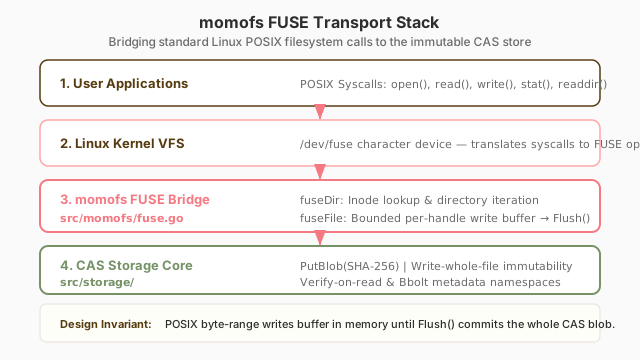
The pieces:
- Mount entrypoint. Running the daemon in filesystem mode (
momo -imp fs) with a mount point and an optional data directory starts a FUSE server. The server is context-cancellable, and onSIGINTorSIGTERMthe process unmounts cleanly before exiting. - The FUSE adapter. A set of node types model the tree to the kernel: a root,
directories, files, and per-open handles for files and directories. Every error
the core can return is mapped to the matching POSIX error code (the
errnothe kernel expects) so that a missing file returns “not found” rather than a generic failure. - Writes buffer per handle, not per file. The kernel writes files in arbitrary byte ranges; our CAS layer wants a whole blob. The adapter keeps a bounded buffer per open handle and materializes a single whole blob on flush or release. Reads go the other way and stream from the core.
- Testing that respects the environment. Node and handle behavior is covered
by unit tests, and a kernel round-trip end-to-end test runs against a real
/dev/fusemount — but self-skips on machines (such as most CI runners) where/dev/fuseis absent. Goroutine-leak and race-detector checks accompany it.
| |
Implemented vs. Planned (Honesty Note)
The POSIX write model and metadata semantics described here are implemented —
the core plus the transport plus the mount user guide all agree. What is still
planned is finer-grained write behavior: full mmap byte-range correctness and
POSIX locks. Today, writes are buffered per handle and materialized whole on
flush; truncation size hints are accepted but their semantics land with the
byte-range follow-up.
⚡ Bolt + 🛡 Sentinel Lens
- ⚡ Bolt: per-handle write buffers are bounded, so memory does not grow without limit during large in-flight writes; reads stream rather than copy the blob into daemon memory.
- 🛡 Sentinel: a clean unmount is a safety property, not housekeeping. A stale FUSE mount left behind by a crash presents a partial tree, so shutdown unmounts deliberately; scatter operations stay lease-validating so rename and refcount survive across the transport.
Failure Modes
| Risk | Guard |
|---|---|
| Daemon crash leaves a dead mount | Kernel marks the mount dead; shutdown path unmounts on signal |
| Large write overwhelms daemon memory | Per-handle buffer is bounded and refuses beyond the cap |
| Native write invisible in mount | Manifests are read fresh, so reads are read-your-own-writes |
| Core error surfaces as generic failure | Errors are mapped to precise POSIX codes |
CI lacks /dev/fuse | Kernel e2e self-skips; unit tests still run |
When NOT to Use This
- Non-Linux hosts. FUSE here targets Linux
/dev/fuse; macOS and Windows use different transports (see the migration post and the roadmap). - Pure object workloads. If no program needs the mount, the FUSE hop is pure overhead — use the native or S3 interface instead.
- Write-heavy large appends today. Whole-blob materialization makes large append workloads pay whole-file cost until the byte-range follow-up lands.
References / Dig deeper
- Spec:
openspec/changes/r4-momofs. - Pull request #963; tracking issue #962.
- The core underneath: 022: momofs POSIX Core.
- Byte layer: 004: Content-Addressable Storage.
- Where R4 sits: 028: Roadmap and Research.
- Later migration to go-fuse/v2: 029: Migrating to go-fuse/v2.
- Operational docs:
docs/momofs/MOUNT_USER_GUIDE.md,docs/momofs/IMPLEMENTATION.md.