Every system that wants to be taken seriously has to answer a boring question: what is left before someone can run this in production? For a long time our answer was a mental list. This post is the moment we wrote the list down, ordered it, and started checking items off — and the reading list that fed the ideas in the first place.
Where the arc stands
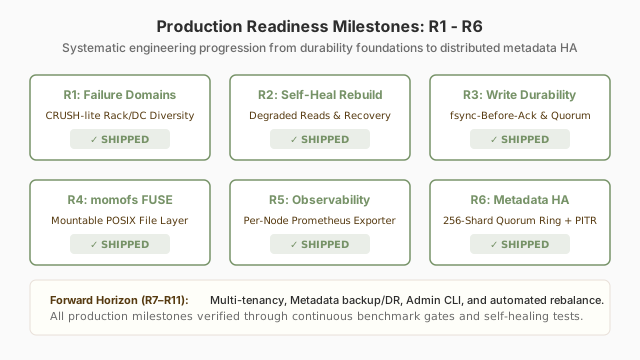
The P0 track — correctness and durability — is done. We worked through it in order, each rung depending on the last:
- R1 — failure domains: place replicas so that one rack or machine going dark does not take every copy of an object with it.
- R2 — degraded reads and self-heal: when a replica is missing, serve from what remains and repair the gap in the background instead of failing the read.
- R3 — write durability and quorum: a write is acknowledged only once enough replicas hold it, so an acknowledged write survives a node loss.
- R4 — mountable POSIX filesystem: expose the object store as a normal filesystem mount, first in userspace, then over a faster transport.
With the correctness floor in place, the remaining work splits into two tracks: P1 (operability, multi-tenancy, security) and P2 (S3 API breadth).
| ID | Item |
|---|---|
| R5 | Metrics 2–4 + dashboards/alerts (seed: 026) |
| R6 | Metadata catalog HA + backup/recovery |
| R7 | Error model & ops (out-of-space surfacing, exit codes) |
| R8 | Multi-tenancy + authorization + audit |
| R9 | Secrets management + key rotation |
| R10 | S3 lifecycle/versioning/notification/lock breadth |
| R11 | Auto-rebalance on membership change |
Some of these deserve a gloss. Metadata catalog HA means the index that maps object names to locations must survive a node loss and be restorable from backup. Out-of-space surfacing means turning a raw disk-full error into a clear, actionable signal instead of a mysterious failure. Auto-rebalance means that when a node joins or leaves, the cluster moves data to restore the placement guarantees without an operator running a script by hand.
The research guide
None of this was invented in a vacuum. The design leans on published work: quorum theory (when is a write durable?), SWIM/gossip (how do peers detect failure without a central monitor?), CRUSH/RADOS (how do you place data deterministically without a directory?), private set membership using an oblivious pseudorandom function (how do you check membership without revealing the query?), and filesystem semantics for the mount layer. We keep a curated reading list so the “why” behind each mechanism is one hop away.
Our durable lens, stated once: code is the implementation; research is the why; specs are the contract; posts are the narrative. Each artifact has a job, and this journal is the one that explains rather than specifies.
References / Dig deeper
- Roadmap: docs/GUIDES/ROADMAP.md.
- Research reading list: docs/RESEARCH_PAPERS.md.
- Spec:
openspec/changes/prod-ready-roadmap. - Completed P0 stack: 019, 020, 021, 022, 023.