“Should everything be a plugin?” The question arrives whenever a codebase wants adaptive, mutating behavior — the ability to swap in a new read-verification policy, a new replication strategy, or a new filesystem policy without a rebuild. For momo the answer was no, and the distinction matters.
The vocabulary first. A plugin in the dynamic sense is code loaded at runtime — a shared object, a separate process, or a remote procedure call — that the host did not compile and cannot fully audit. A seam is the opposite: a small Go interface compiled into the binary at a known decision point, where the concrete implementation is chosen by configuration. The fast path is the common, happy case that must stay lean; the trust core is the set of invariants (content addressing, placement, integrity) that must never be swappable. A policy is declarative data that selects behavior; fail closed means an unknown or absent policy falls back to the safe default.
The Real Problem
We wanted adaptability without paying for it in latency or trust. Two forces pushed in opposite directions. The data path is performance-critical: an RPC hop per decision would break the byte flow and add allocation to every transfer. And the storage node is security-critical: loading unreviewed code onto a node that holds other people’s data is a Trojan surface, not a feature.
Why the Obvious Solutions Failed
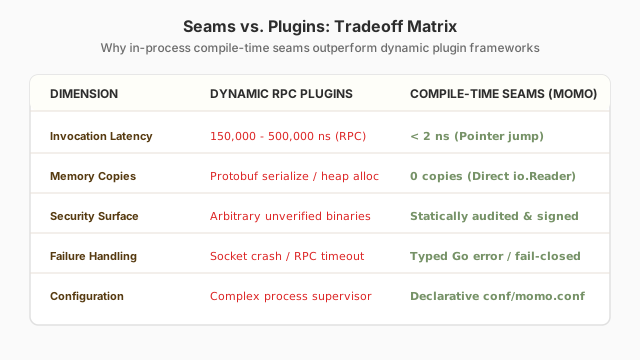
| External dynamic plugins | In-process seams (chosen) | |
|---|---|---|
| Loading | shared objects, subprocesses, cross-process RPC | compiled-in Go interface |
| Fast path | serialization and allocation tax | concrete, zero-indirection |
| Trust | executing unreviewed code | compile-time auditable |
| Versioning | pinning pain across processes | a single binary |
Dynamic plugins are the right answer when the extension authors are unknown and the host must isolate them — think a browser extension or an editor. They are the wrong answer for a storage node whose entire value proposition is predictable performance and auditable behavior.
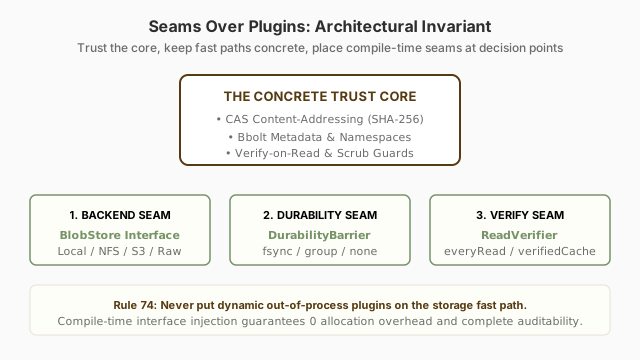
The constraint that decided it: seam over the changeable, keep the fast path concrete. Seams dispatch only at decision points, never inside the byte stream.
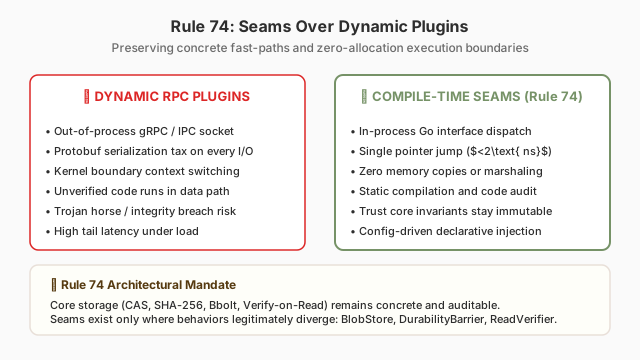
The Rule
We codified the architecture as a steering rule with five commitments:
- Adaptive, mutating behaviors are seams — Go interfaces such as a read verifier, a rebuild converger, a filesystem policy, a replication strategy, and a durability barrier.
- Fast paths stay concrete — seams dispatch at decision points only, never per byte.
- Trust-core invariants are pinned — content addressing, content hashing, placement, verify-on-read, and the single validate-then-write chokepoint stay compiled into the auditable core.
- Policy is declarative — behavior is selected by swapping a policy struct through an atomic pointer at runtime, never by mutating code.
- Fail closed — an unknown or absent strategy falls back to the safe default rather than guessing.
Examples Already in the Tree
- The read verifier seam — trust-earned read verification, where a blob that has proven itself is verified less often.
- The durability barrier seam — fsync, group commit, or no barrier behind one interface.
- The checksum provider seam — protocol-agnostic integrity verification, so every transport reports expectations the same way.
⚡ Bolt / 🛡 Sentinel lens
⚡ Bolt: concrete fast path, zero indirection, no RPC in the data plane. 🛡 Sentinel: fail-closed policy, no dynamic code loading, the trust core pinned and auditable. Out-of-process code is allowed only as a read-only policy or control-plane feed, never in the compute plane.
See docs/CORE/STANDARDS.md for the ⚡ Bolt / 🛡 Sentinel mindsets.